The challenges of Europe

The European Strategy and Policy Analysis System (ESPAS) recently published a quiet interesting report on “Global Trends to 2030: Can the EU Meet the Challenges Ahead?”.

It is sometimes useful to look beyond our nose and the daily debate on agri-food issues, and think about with a broader perspective, and this is why I try to do today with this post.

In this case, the ESPAS Report proposes 5 global trends that are going to be critical in the years to come (in fact, they already are):

  1. We are getting older and richer, with a global middle class emerging at the same time as inequalities.
  2. Economic weight is shifting to Asia.
  3. IT will transform societies in almost every aspects.
  4. Managing scarcity of resources is an increasingly challenge.
  5. The interpedendence of countries is not matched by stronger global governance.

It is interesting to see that all of this issues have a strong, direct relationship with food. The point is, are we really aware of it? In other words, is the European Union reacting consequently to this challenges or are we somehow “lost in space “, or at least adopting an attitude of “business as usual”?

That’s a big question. Personally, I think that much more can be done, and should be done, to catch up.

Comments are welcomed…

¡Suscribete para estar al tanto de los ultimos post!

¡No hacemos spam! Lee nuestra política de privacidad para obtener más información.

Compartir el post

Más Articulos

¿PUEDE EL ESTADO FIJAR DE FACTO EL PRECIO DE LOS ALIMENTOS?

La sentencia Penny Market y los límites europeos a la intervención en los mercados alimentarios. La reciente sentencia del Tribunal de Justicia de la Unión Europea (TJUE) en el asunto Penny Market plantea una cuestión de enorme relevancia para el futuro de las políticas alimentarias europeas: ¿pueden los Estados intervenir directamente en la formación de los precios de los alimentos

Leer más»

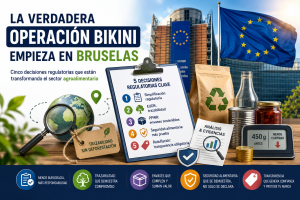
LA VERDADERA OPERACIÓN BIKINI EMPIEZA EN BRUSELAS: CINCO DECISIONES REGULATORIAS QUE ESTÁN TRANSFORMANDO EL SECTOR AGROALIMENTARIO.

Quizá la auténtica operación bikini de 2026 no consista en reducir calorías, sino en revisar etiquetas, envases, proveedores, fichas técnicas, claims… antes de que lo haga el regulador… porque, en un mercado donde la salud gana peso y la regulación también, la mejor preparación para el verano puede ser una buena estrategia de cumplimiento. Estas son cinco decisiones (o frentes

Leer más»

¿UN VIRAJE DE FONDO? RESUMEN DE LA COMUNICACION DE LA COMISION “SIMPLER, CLEARER AND BETTER ENFORCED EU RULEBOOK”.

  La Comisión ha adoptado la Comunicación a Simpler, Clearer and Better Enforced EU Rulebook. Se trata de toda una clara declaración de intenciones para mejorar la forma en que se adoptan las decisiones en Bruselas, y reforzar la aplicación efectiva de la norma comunitaria por los EM. Es otra muestra más del profundo cambio que está experimentando Bruselas. Primero se

Leer más»

Comisión von der Leyen II: Balance de agenda a marzo de 2026

Del documento extraemos una serie de pistas relevantes para saber cuál será el rol que desempeñará el sector agroalimentario en la Agenda de la Comisión Europea: El sector sigue siendonecesario políticamente, pero ya no estructura la agenda europea comoen décadas anteriores. Las decisiones relevantes para el sector vendráncada vez más condicionadas por políticas industriales, energéticas o deseguridad. El sector apareceencuadrado

Leer más»